Exercise: Counters

Questions for: Counters

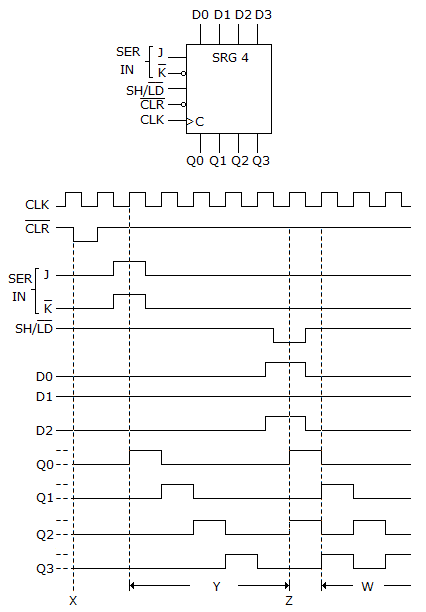
What type of register is shown below?

A:
Parallel in/parallel out register
B:
Serial in/parallel out register
C:
Serial/parallel-in parallel-out register
D:
Parallel-access shift register
Answer: D
No answer description is available. Let's discuss.
What is the difference between a 7490 and a 7492?
A:
7490 is a MOD-12, 7492 is a MOD-10
B:
7490 is a MOD-12, 7492 is a MOD-16
C:
7490 is a MOD-16, 7492 is a MOD-10
D:
7490 is a MOD-10, 7492 is a MOD-12
Answer: D
No answer description is available. Let's discuss.
What is the difference between combinational logic and sequential logic?
A:
Combinational circuits are not triggered by timing pulses, sequential circuits are triggered by timing pulses.
B:
Combinational and sequential circuits are both triggered by timing pulses.
C:
Neither circuit is triggered by timing pulses.
D:
Answer: A
No answer description is available. Let's discuss.
Synchronous counters eliminate the delay problems encountered with asynchronous counters because the:
A:
input clock pulses are applied only to the first and last stages
B:
input clock pulses are applied only to the last stage
C:
input clock pulses are not used to activate any of the counter stages
D:
input clock pulses are applied simultaneously to each stage
Answer: D
No answer description is available. Let's discuss.
Synchronous construction reduces the delay time of a counter to the delay of:
A:
all flip-flops and gates
B:
all flip-flops and gates after a 3 count
C:
a single gate
D:
a single flip-flop and a gate
Answer: D
No answer description is available. Let's discuss.
Ad Slot (Above Pagination)
Quiz