Exercise: Counters

Questions for: Counters

Which of the following is an example of a counter with a truncated modulus?
A:
8
B:
13
C:
16
D:
32
Answer: B
No answer description is available. Let's discuss.
What is meant by parallel load of a counter?
A:
Each FF is loaded with data on a separate clock.
B:
The counter is cleared.
C:
All FFs are preset with data.
D:
Answer: C
No answer description is available. Let's discuss.
A multiplexed display being driven by a logic circuit:
A:
accepts data inputs from one line and passes this data to multiple output lines
B:
accepts data inputs from several lines and allows one of them at a time to pass to the output
C:
accepts data inputs from multiple lines and passes this data to multiple output lines
D:
accepts data inputs from several lines and multiplexes this input data to four BCD lines
Answer: B
No answer description is available. Let's discuss.
Why can a synchronous counter operate at a higher frequency than a ripple counter?
A:
The flip-flops change one after the other.
B:
The flip-flops change at the same time.
C:
A synchronous counter cannot operate at higher frequencies.
D:
A ripple counter is faster.
Answer: B
No answer description is available. Let's discuss.

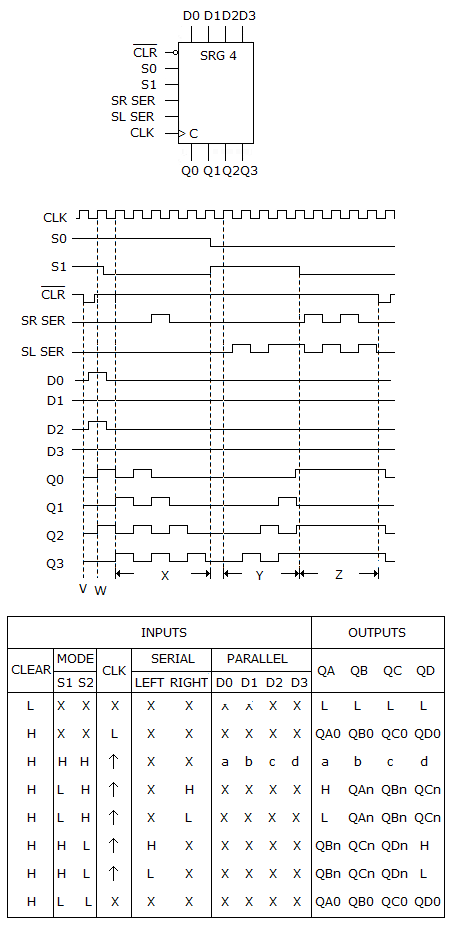
What type of device is shown below?

A:
4-bit bidirectional universal shift register
B:
Parallel in/parallel out shift register with bidirectional data flow
C:
2-way parallel in/serial out bidirectional register
D:
2-bit serial in/4-bit parallel out bidirectional shift register
Answer: A
No answer description is available. Let's discuss.
Ad Slot (Above Pagination)
Quiz