Questions for: Analytical Reasoning
How many circles are there in the adjoining figure.
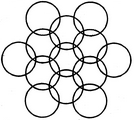
The figure may be labelled as shown.

There are 13 circles in the given figure. This is clear from the adjoining figure in which the centres of all the circles in the given figure have been numbered from 1 to 13.
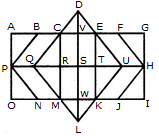
Determine the number of rectangles and hexagons in the given figure.

The figure may be labelled as shown.
Rectangles:
The simplest rectangles are CVSR, VETS, RSWM and STKW i.e. 4 in number.
The rectangles composed of two components each are CETR, VEKW, RTKM and CVWM i.e. 4 in number.
The rectangles composed of three components each are ACRP, PRMO, EGHT and THIK i.e. 4 in number.
The rectangles composed of four components each are CEKM, AVSP,PSWO, VGHS and SHIW i.e. 5 in number.
The rectangles composed of five components each are AETP, PTKO, CGHR and RHIM i.e. 4 in number.
The rectangles composed of six components each are ACMO and EGIK i.e. 2 in number.
The rectangles composed of eight components each are AGHP, PHIO, AVWO and VGIW i.e. 4 in number.
The rectangles composed of ten components each are AEKO and CGIM i.e. 2 in number.
AGIO is the only rectangle having sixteen components.
Total number of rectangles in the given figure
= 4 + 4 + 4 + 5 + 4 + 2 + 4 + 2 + 1 = 30.
Hexagons:
The hexagons in the given figure are CDEKLM, CEUKMQ, CFHJMQ, BEUKNP and BFHJNP.
So, there are 5 hexagons in the given figure.
How many rectangles are there in the given figure.

The figure may be labelled as shown.

The simplest rectangles are ABJI, BCKJ, IJFG and JKEF i.e. 4 in number.
The rectangles composed of two components each are ACKI, BCEF, IKEG and ABFG i.e. 4 in number.
The only rectangle composed of four components is ACEG.
Thus, there are 4 + 4 + 1 = 9 rectangles in the given figure.
What is the minimum number of straight lines that is needed to construct the figure?

The figure may be labelled as shown.
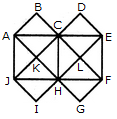
The horizontal lines are AE and JF i.e. 2 in number. The vertical lines are AJ, CH and EF i.e. 3 in number.
The slanting lines are AG, BF, JD, IE, AB, DE, JI and FG i.e. 8 in number.
Total number of straight lines needed to construct the figure = 2 + 3 + 8 = 13.
Count the number of rectangles in the given figure.

The figure may be labelled as shown.

The rectangles composed of two components each are HIJE, EKJ,F, FMNG, GPQH, AEOH, EBFO, OFCG and HOGD i.e. 8 in number.
The rectangles composed of four components each are ABFH, BCGE, CDHF, DAEG and EFGH i.e. 5 in number.
The rectangles composed of six components each are IJFG, KLGH, MNHE and PQEF i.e. 4 in number.
The rectangles composed of eight components each are IJMN, KLPQ and ABCD i.e. 3 in number.
Thus, there are 8 + 5 + 4 + 3 = 20 rectangles in the given figure.
(Here note that the squares are also counted amongst rectangles)

Discuss About this Question.