Questions for: Analytical Reasoning
Count the number of triangles and squares in the given figure.

The figure may be labelled as shown.
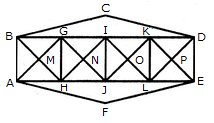
Triangles:
The simplest triangles are BGM, GHM, HAM, ABM, GIN, UN, JHN, HGN, IKO, KLO, LJO, JIO, KDP, DEP, ELP, LKP, BCD and AFE i.e. 18 in number.
The triangles composed of two components each are ABG, BGH, GHA, HAB, HGI, GIJ, IJH, JHG, JIK, IKL, KLJ, LJI, LKD, KDE, DEL and ELK i.e. 16 in number.
The triangles composed of four components each are BHI, GJK, ILD, AGJ, HIL and JKE i.e. 6 in number.
Total number of triangles in the figure = 18 +16 + 6 = 40.
Squares :
The squares composed of two components each are MGNH, NIOJ and OKPL i.e. 3 in number.
The squares composed of four components each are BGHA, GIJH, IKLJ and KDEL i.e. 4 in number.
Total number of squares in the figure = 3 + 4 = 7.
What is the minimum number of colours required to fill the spaces in the given diagram without any two adjacent spaces having the same colour?

The figure may be labelled as shown.
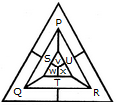
The spaces P, Q and R have to be shaded by three different colours definitely (since each of these three spaces lies adjacent to the other two).
Now, in order that no two adjacent spaces be shaded by the same colour, the spaces T, U and S must be shaded with the colours of the spaces P, Q and R respectively.
Also the spaces X, V and W must be shaded with the colours of the spaces S, T and U respectively i.e. with the colours of the spaces R, P and Q respectively. Thus, minimum three colours are required.
Find the number of quadrilaterals in the given figure.

The figure may be labelled as shown.
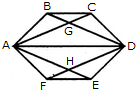
The quadrilaterals in the figure are ABCD, ABDE, ABDF, ABDH, CDHA, CDEA, CDFA, DEAG, DEFA, FAGD and AGDH.
The number of quadrilaterals in the figure is 11.
Count the number of squares in the given figure.

The figure may be labelled as shown.
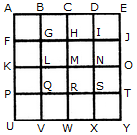
The simplest squares are ABGF, BCHG, CDIH, DEJI, FGLK, GHML, HINM, IJON, KLQP, LMRQ, MNSR, NOTS, PQVU, QRWV, RSXW and STYX i.e. 16 in number.
The squares composed of four components each are ACMK, BDNL, CEOM, FHRP, GISQ, HJTR, KMWU, LNXV and MOYW i.e. 9 in number.
The squares composed of nine components each are ADSP, BETQ, FIXU and GJYV i.e. 4 in number.
There is one square AEYU composed of sixteen components.
There are 16 + 9 + 4 + 1 = 30 squares in the given figure.
What is the number of triangles that can be formed whose vertices are the vertices of an octagon but have only one side common with that of octagon?
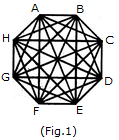
When the triangles are drawn in an octagon with vertices same as those of the octagon and having one side common to that of the octagon, the figure will appear as shown in (Fig. 1).
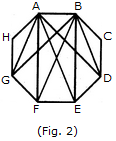
Now, we shall first consider the triangles having only one side AB common with octagon ABCDEFGH and having vertices common with the octagon (See Fig. 2).Such triangles are ABD, ABE, ABF and ABG i.e. 4 in number.
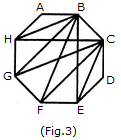
Similarly, the triangles having only one side BC common with the octagon and also having vertices common with the octagon are BCE, BCF, BCG and BCH (as shown in Fig. 3). i.e. There are 4 such triangles.
This way, we have 4 triangles for each side of the octagon. Thus, there are 8 x 4 = 32 such triangles.

Discuss About this Question.