Questions for: Analytical Reasoning
Count the number of convex pentagons in the adjoining figure.

A convex pentagon has no angles pointing inwards. More precisely, no internal angles can be more than 180°.
The figure may be labelled as shown.

The pentagons in the figure, are ABDFH, CDFHB, EFHBD, GHBDF, ACDFG, CEFHA, EGHBC, GABDE, BDEGH, DFGAB, FHACD and HBCEF. Clearly, these are 12 in number.
How many triangles and parallelograms are there in the following figure?

The figure may be labelled as shown.
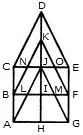
Triangles:
The simplest triangles are KJN, KJO, CNB, OEF, JIL, JIM, BLA and MFG i.e. 8 in number.
The triangles composed of two components each are CDJ, EDJ, NKO, JLM, JAH and JGH i.e. 6 in number.
The triangles composed of three components each are BKI, FKI, CJA and EJG i.e. 4 in number.
The triangles composed of four components each are CDE and AJG i.e. 2 in number.
The only triangle composed of six components is BKF.
Thus, there are 8 + 6 + 4 + 2 + 1 = 21 triangles in the given figure.
Parallelograms :
The simplest parallelograms are NJLB and JOFM i.e. 2 in number.
The parallelograms composed of two components each are CDKB, DEFK, BIHA and IFGH i.e.4 in number.
The parallelograms composed of three components each are BKJA, KFGJ, CJIB and JEFI i.e.4 in number.
There is only one parallelogram i.e. BFGA composed of four components.
The parallelograms composed of five components each are CDJA, DEGJ, CJHA and JEGH i.e.4 in number.
The only parallelogram composed of six components is CEFB.
The only parallelogram composed of ten components is CEGA.
Thus, there are 2 + 4 + 4 + 1 + 4+ 1 + 1 = 17 parallelograms in the given figure.
(Here note that the squares and rectangles are also counted amongst the parallelograms).
In the adjoining figure, if the centres of all the circles are joined by horizontal and vertical lines, then find the number of squares that can be formed.
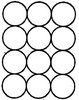
The figure may be labelled as shown.
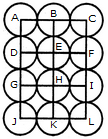
We shall join the centres of all the circles by horizontal and vertical lines and then label the resulting figure as shown.
The simplest squares are ABED, BCFE, DEHG, EFIH, GHKJ and HILK i.e. 6 in number.
The squares composed of four simple squares are ACIG and DFLJ i.e. 2 in number.
Thus, 6 + 2 = 8 squares will be formed.
Count the number of parallelogram in the given figure.

The figure may be labelled as shown.
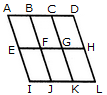
The simplest ||gms are ABFE, BCGF, CDHG, EFJI, FGKJ and GHLK. These are 6 in number.
The parallelograms composed of two components each are ACGE, BDHF, EGKI, FHLJ, ABJI, BCKJ and CDLK. Thus, there are 7 such parallelograms.
The parallelograms composed of three components each are ADHE and EHLI i.e. 2 in number.
The parallelograms composed of four components each are ACKI and BDLJ i.e. 2 in number
There is only one parallelogram composed of six components, namely ADLI.
Thus, there are 6 + 7 + 2 + 2 + 1 = 18 parallelograms in the figure.
What is the minimum number of different colours required to paint he given figure such that no two adjacent regions have the same colour?
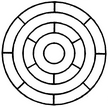
The figure may be labelled as shown.
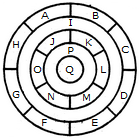
The regions A, C, E and G can have the same colour say colour 1.
The regions B, D, F and H can have the same colour (but different from colour 1) say colour 2.
The region 1 lies adjacent to each one of the regions A, B, C, D, E, F, G and H and therefore it should have a different colour say colour 3.
The regions J, L and N can have the same colour (different from colour 3) say colour 1.
The regions K, M and O can have the same colour (different fromthe colours 1 and 3). Thus, these regions will have colour 2.
The region P cannot have any of the colours 1 and 2 as it lies adjacent to each one of the regions J, K, L, M, N and O and so it will have colour 3.
The region Q can have any of the colours 1 or 2.
Minimum number of colours required is 3.

Discuss About this Question.