Exercise: Time Response Of Reactive Circuits

Questions for: Time Response Of Reactive Circuits

In an RC differentiator, the sum of the capacitor voltage and the resistor voltage at any instant
A:
must be zero
B:
must be equal to the applied voltage
C:
is less than the applied voltage but greater than zero
D:
cannot be determined
Answer: B
No answer description is available. Let's discuss.
The output of an RC integrator is taken across the
A:
diode
B:
capacitor
C:
resistor
D:
source
Answer: B
No answer description is available. Let's discuss.
In an RC differentiator, responding to repetitive pulses, the average value of the output
A:
is zero
B:
is equal to the input voltage
C:
is 63 percent of the input voltage
D:
cannot be determined
Answer: A
No answer description is available. Let's discuss.
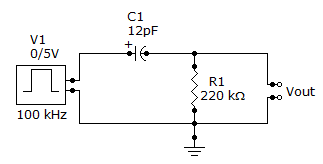
Referring this figure, on the falling edge,
A:
the resistor voltage drops to –5 V and then goes back to zero exponentially
B:
the resistor voltage jumps to –5 V and then goes back to zero exponentially
C:
the capacitor voltage remains constant
D:
the resistor voltage jumps to +5 V and then decreases exponentially to zero
Answer: B
No answer description is available. Let's discuss.
In an RL differentiator, when the input pulse goes from its low level to its high level,
A:
the inductor prevents a sudden change in voltage
B:
the inductor prevents a sudden change in current
C:
voltage across the inductor instantly reaches 63% of input voltage
D:
voltage across the inductor is zero
Answer: B
No answer description is available. Let's discuss.
Ad Slot (Above Pagination)
Quiz