Exercise: Series Parallel Circuits

Questions for: Series Parallel Circuits
In a series–parallel circuit, individual component power dissipations are calculated using:
A:
individual component parameters
B:
a percent of the voltage division ratio squared
C:
total current squared multiplied by the resistor values
D:
a percent of the total power depending on resistor ratios
Answer: A
No answer description is available. Let's discuss.

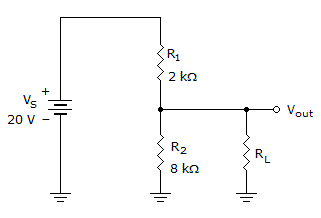
If the load in the given circuit is 120 komega.gif , what is the loaded output voltage?

A:
4.21 V
B:
15.79 V
C:
16 V
D:
19.67 V
Answer: B
No answer description is available. Let's discuss.
What is the power dissipated by R2, R4, and R6?

A:
P2 = 417 mW, P4 = 193 mW, P6 = 166 mW
B:
P2 = 407 mW, P4 = 183 mW, P6 = 156 mW
C:
P2 = 397 mW, P4 = 173 mW, P6 = 146 mW
D:
P2 = 387 mW, P4 = 163 mW, P6 = 136 mW
Answer: A
No answer description is available. Let's discuss.
What theorem replaces a complex network with an equivalent circuit containing a source voltage and a series resistance?
A:
Multinetwork
B:
Norton
C:
Thevenin
D:
Superposition
Answer: C
No answer description is available. Let's discuss.
A galvanometer is a meter that measures small amounts of voltage.
A:
True
B:
False
C:
D:
Answer: B
No answer description is available. Let's discuss.
Ad Slot (Above Pagination)
Quiz