Questions for: Planar Kinetics Of A Rigid Body Impulse And Momentum

A constant torque or twist of M = 0.4N • m is applied to the center gear A. If the system starts from rest, determine the angular velocity of each of the three (equal) smaller gears in 3 s. The smaller gears (B) are pinned at their centers, and the mass and centroidal radii of gyration of the gears are given in the figure.
 B = 1975 rad/sB = 5830 rad/sB = 1520 rad/sB = 1022 rad/s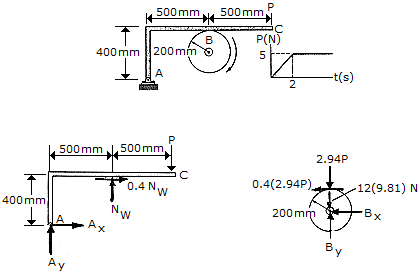
The 12-kg disk has an angular velocity of = 20 rad/s. If the brake ABC is applied such that the magnitude of force P varies with time as shown, determine the time needed to stop the disk. The coefficient of friction at B is  = 0.4.
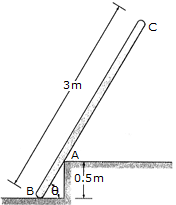
The uniform pole has a mass of 15 kg and falls from rest when  = 90° until it strikes the edge at A, = 60°. If the pole then begins to pivot about this point after contact, determine the pole's angular velocity just after the impact. Assume that the pole does not slip at B as it falls until it strikes A.
3 = 1.146 rad/s3 = 0.537 rad/s3 = 2.15 rad/s3 = 1.528 rad/s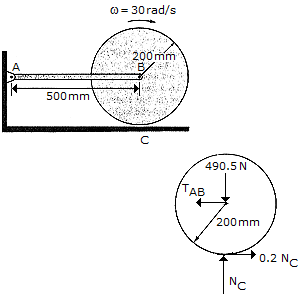
The 50-kg cylinder has an angular velocity of 30 rad/s when it is brought into contact with the horizontal surface at C. If the coefficient of friction is c = 0.2, determine how long it takes for the cylinder to stop spinning. What force is developed at the pin A during this time? The axis of the cylinder is connected to two symmetrical links. (Only AB is shown.) For the computation, neglect the weight of the links.

Gear A has a weight of 1.5 lb, a radius of 0.2 ft, and a radius of gyration of ko = 0.13ft. The coefficient of friction between the gear rack B and the horizontal surface is = 0.3. If the rack has a weight of 0.8 lb and is initially sliding to the left with a velocity of (vB)2 = 8 ft/s to the left. Neglect friction between the rack and the gear and assume that the gear exerts only a horizontal force on the rack.

Discuss About this Question.