Exercise: Microwave Communication

Questions for: Microwave Communication

In a TWT the amplitude of resultant wave travelling down the helix
A:
increases exponentially
B:
increases linearly
C:
decreases exponentially
D:
is almost constant
Answer: A

In a klystron the resonant structure limits the bandwidth.

A TWT is a broadband device. Its main components are electron gun (to produce the electron beam) and a structure supporting the slow electromagnetic wave.

The velocity of wave propagation along the helix structure is less than velocity of light.

The beam and wave travel along the structure at the same speed.

Thus interaction occurs between beam and wave and the beam delivers energy to the RF wave.

Therefore the signal gets strengthened and amplified output is delivered at the other end of tube.

The main features of TWT are :

1. Frequency range - 0.5 GHz to 90 GHz

2. Power output - 5 mW at low frequencies(less than 20 GHz) 250 kW (continuous wave) at 3 GHz 10 MW (pulsed) at 3 GHz

3. Efficiency - about 5 to 20%

4. Noise - about 5 dB for low power TWT 25 dB for high power TWT

TWT is used as RF amplifier in broadband microwave receivers, repeater amplifier in broad band communication systems, communication satellites etc.
Assertion (A): TWT uses a focussing mechanism to prevent the electron beam from spreading.

Reason (R): In a TWT the electron beam has to travel a much longer distance than in klystron.

A:
Both A and R are correct and R is correct explanation of A
B:
Both A and R are correct but R is not correct explanation of A
C:
A is correct but R is wrong
D:
A is wrong but R is correct
Answer: A

In a klystron the resonant structure limits the bandwidth.

A TWT is a broadband device. Its main components are electron gun (to produce the electron beam) and a structure supporting the slow electromagnetic wave.

The velocity of wave propagation along the helix structure is less than velocity of light.

The beam and wave travel along the structure at the same speed.

Thus interaction occurs between beam and wave and the beam delivers energy to the RF wave.

Therefore the signal gets strengthened and amplified output is delivered at the other end of tube.

The main features of TWT are :

1. Frequency range - 0.5 GHz to 90 GHz

2. Power output - 5 mW at low frequencies(less than 20 GHz) 250 kW (continuous wave) at 3 GHz 10 MW (pulsed) at 3 GHz

3. Efficiency - about 5 to 20%

4. Noise - about 5 dB for low power TWT 25 dB for high power TWT

TWT is used as RF amplifier in broadband microwave receivers, repeater amplifier in broad band communication systems, communication satellites etc.

Microwave resonators are used in
A:
microwave oscillators
B:
microwave narrow band amplifier
C:
microwave frequency metres
D:
all of the above
Answer: D

They are used in all the devices.

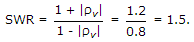
The reflection coefficient on a line is 0.2 ∠45°. The SWR is
A:
0.8
B:
1.1
C:
1.2
D:
1.5
Answer: D

In a circular waveguide the dominant mode is
A:
TE01
B:
TE11
C:
TE20
D:
TE21
Answer: B

Some applications require dual polarization capability. Circular waveguide has this capability.

These analysis uses cylindrical coordinates.

In circular waveguide TE11 mode has the lowest cut off frequency and is the dominant mode.

If D is diameter of waveguide

λc = 1.706 D for TE11 mode

λc = 1.029 D for TE21 mode

λc = 0.82 D for TE01 mode

λc = 1.306 D for TM01 mode.

Ad Slot (Above Pagination)
Quiz