Exercise: Microwave Communication

Questions for: Microwave Communication

Assertion (A): A half wavelength line can be used as a 1 : 1 transformer.

Reason (R): The input impedance of a half wavelength line is equal to load impedance.

A:
Both A and R are correct and R is correct explanation of A
B:
Both A and R are correct but R is not correct explanation of A
C:
A is correct but R is wrong
D:
A is wrong but R is correct
Answer: A

Since a half wavelength line has an input impedance equal to load impedance, the impedance transformation ratio is 1:1.

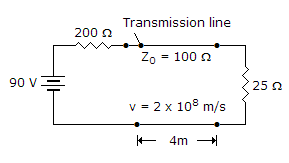
In the given figure the reflected voltage wave after first reflection is
A:
18 V
B:
-18 V
C:
30 V
D:
-30 V
Answer: B

.

For a circular wave guide
A:
cutoff frequency for TE10 and TE01 modes are same
B:
cutoff frequency for TE10 and TE01 modes are different
C:
cutoff frequency for TE10 mode = twice the cutoff frequency for TE20 mode
D:
cutoff frequency for TE10 mode = haf the cutoff frequency for TE20 mode
Answer: A

When a circular waveguide is rotated by 90°, the configuration remain the same.

If other parameter are constant, transmission loss at 5 GHz as compared to that at 0.5 GHz is
A:
20 dB more
B:
20 dB less
C:
700 dB more
D:
100 dB less
Answer: A

As frequency increases, transmission loss increases slightly.

In a TWT the axial component of electric field advances along the tube
A:
at a velocity that is almost equal to speed of light
B:
at a velocity that is a small fraction of speed of light
C:
at a velocity that is about 50% of speed of light
D:
at a velocity that may be even more than speed of light
Answer: B

In a klystron the resonant structure limits the bandwidth.

A TWT is a broadband device. Its main components are electron gun (to produce the electron beam) and a structure supporting the slow electromagnetic wave.

The velocity of wave propagation along the helix structure is less than velocity of light.

The beam and wave travel along the structure at the same speed.

Thus interaction occurs between beam and wave and the beam delivers energy to the RF wave.

Therefore the signal gets strengthened and amplified output is delivered at the other end of tube.

The main features of TWT are :

1. Frequency range - 0.5 GHz to 90 GHz

2. Power output - 5 mW at low frequencies(less than 20 GHz) 250 kW (continuous wave) at 3 GHz 10 MW (pulsed) at 3 GHz

3. Efficiency - about 5 to 20%

4. Noise - about 5 dB for low power TWT 25 dB for high power TWT

TWT is used as RF amplifier in broadband microwave receivers, repeater amplifier in broad band communication systems, communication satellites etc.
Ad Slot (Above Pagination)
Quiz