Exercise: Exam Question Papers
Questions for: Exam Question Papers
The transfer characteristic for the precision rectifier circuit shown below is (assume ideal OP-AMP and practical diodes)

A: 
B: 
C: 
D: 
Answer: B
When Vi = - 10 V0 = 5.
In the following circuit , the comparator output in log: "I" if V1 > V2 and is logic "0" otherwise. The D/A conversion is done as per the relations VDAC =  2n-2 Volts, where b3 (MSB), b2, b1 and b0 (LSB) are the counter outputs. The counter starts from the clear state
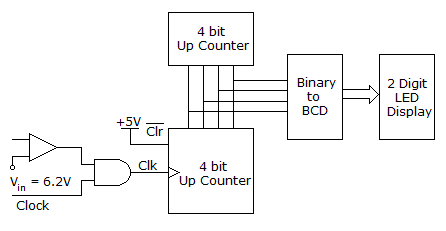
The stable reading of the LED display is
2n-2 Volts, where b3 (MSB), b2, b1 and b0 (LSB) are the counter outputs. The counter starts from the clear stateThe stable reading of the LED display is
Answer: D

Using the given VDAC relation we can get tc
Thus stable reading of LED is 6.5 x 2 = 13.
Find 'X' in the circuit below:
f1(A, B, C, D) = Σ(6, 7, 13, 14);
f2(A, B, C, D) = Σ(3, 6, 7);
f3(A, B, C, D) = Σ(5, 6, 7, 14, 15)

f1(A, B, C, D) = Σ(6, 7, 13, 14);
f2(A, B, C, D) = Σ(3, 6, 7);
f3(A, B, C, D) = Σ(5, 6, 7, 14, 15)
Answer: C
f1(A, B, C, D) = ∑(6, 7, 13, 14)
f2(A, B, C, D) = ∑(3, 6, 7)
f1 ⊕ f2 = ∑(3, 13, 14)
f3 x (f1 ⊕ f2) = ∑(14)= Y
X = f1 x Y = ∑(14).
In the following network, the switch is closed at t = 0 and the sampling starts from t = 0. The sampling frequency is 10Hz.

The samples x(n) (n = 0, 1, 2, ...) are given by
The samples x(n) (n = 0, 1, 2, ...) are given by
Answer: B
Initial voltage across R = 5Vn
Final voltage across R = 0V
Thus VR = 5.0-0.5t
When we sample this at f∂ = 102
We get x(n) =  .
.
In 8085 microprocessor based system running at 3 MHz clock frequency what should be the minimum pulse width of the INTR signal, so that it is recognized successfully?
Answer: C
T =  x 106 = 0.333 μs
8085 checks INTR, one clock period before the last T-state of an instruction cycle. In 8085, CALL instruction requires 18 T-states.
∴ INTR pulse should be high at least for 17.5 T-states
i.e. for 17.5 x 0.33 x 10-6 = 5.8 μs long.
Ad Slot (Above Pagination)

Discuss About this Question.