Questions for: Equilibrium Of A Rigid Body
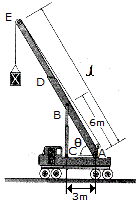
The crane provides a long-reach capacity by using the telescopic boom segment DE. The entire boom is supported by a pin at A and by the telescopic hydraulic cylinder BC, which can be considered as a two-force member. The rated load capacity of the crane is measured by a maximum force developed in the hydraulic cylinder. If this maximum force is developed when the boom supports a mass m = 6 Mg and its length is l = 40 and  = 60°, determine the greatest mass that can be supported when the boom length is extended to l = 50 m and = 45°. Neglect the weight of the boom and the size of the pulley at E. Assume the crane does not overturn. Note: when = 60° BC is vertical; however, when = 45° this is not the case.
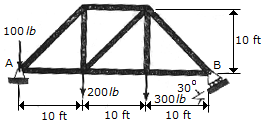
Determine the horizontal and vertical components of reaction at the pin A and the reaction at the roller support B required for equilibrium of the truss.

There is a ball and socket connection at A. At point B there is a connection that opposes motion in the x and z directions only. Determine the unknown force components at A and B. Use a scalar analysis.
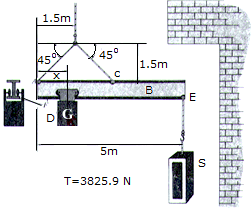
The flying boom B is used with a crane to position construction materials in coves and underhangs. The horizontal "balance" of the boom is controlled by a 250-kg block D, which has a center of gravity at G and moves by internal sensing devices along the bottom flange F of the beam. Determine the position x of the block when the boom is used to lift the stone S, which has a mass of 60 kg. The boom is uniform and has a mass of 80 kg.

The space truss is supported by a ball-and-socket joint at A and short links, two at C and one at D. Determine the x, y, z components of reaction at A and the force in each link.

Discuss About this Question.