#include<stdio.h>
int main()
{
union a
{
int i;
char ch[2];
};
union a u;
u.ch[0] = 3;
u.ch[1] = 2;
printf("%d, %d, %d\n", u.ch[0], u.ch[1], u.i);
return 0;
}
A:
3, 2, 515
B:
515, 2, 3
C:
3, 2, 5
D:
None of these
Answer:A
printf("%d, %d, %d\n", u.ch[0], u.ch[1], u.i); It prints the value of u.ch[0] = 3, u.ch[1] = 2 and it prints the value of u.i means the value of entire union size.
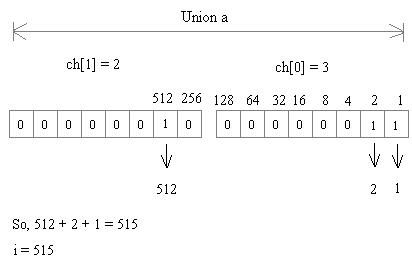
So the output is 3, 2, 515.
Discuss About this Question.
What is the output of the program
#include<stdio.h>
int main()
{
int a[5] = {2, 3};
printf("%d, %d, %d\n", a[2], a[3], a[4]);
return 0;
}
A:
Garbage Values
B:
2, 3, 3
C:
3, 2, 2
D:
0, 0, 0
Answer:D
When an automatic array is partially initialized, the remaining elements are initialized to 0.
Discuss About this Question.
What is the output of the program
#include<stdio.h>
int main()
{
extern int fun(float);
int a;
a = fun(3.14);
printf("%d\n", a);
return 0;
}
int fun(int aa)
{
return (int)++aa;
}
A:
3
B:
3.14
C:
0
D:
4
Answer:E
2 Errors 1. Type mismatch in redeclaration of fun 2. Type mismatch in parameter aa
Discuss About this Question.
What is the output of the program
#include<stdio.h>
int main()
{
int x = 10, y = 20, z = 5, i;
i = x < y < z;
printf("%d\n", i);
return 0;
}
A:
0
B:
1
C:
Error
D:
None of these
Answer:B
Since x < y turns to be TRUE it is replaced by 1. Then 1 < z is compared and to be TRUE. The 1 is assigned to i.
Discuss About this Question.
What will be the output of the program?
#include<stdio.h>
int X=40;
int main()
{
int X=20;
printf("%d\n", X);
return 0;
}
A:
20
B:
40
C:
Error
D:
No Output
Answer:A
Whenever there is conflict between a local variable and global variable, the local variable gets priority.
Discuss About this Question.
Ad Slot (Above Pagination)
Install ExamAdept
Fast access — add this app to your device.
To install on iPhone/iPad: tap Share → Add to Home Screen.
Discuss About this Question.