Exercise: Analog Electronics

Questions for: Analog Electronics

Assertion (A): An op-amp has high voltage gain, high input impedance and low output impedance

Reason (R): Negative feedback increases output impedance

A:
Both A and R are correct and R is correct explanation for A
B:
Both A and R are correct but R is not correct explanation for A
C:
A is correct R is wrong
D:
A is wrong R is correct
Answer: C

Negative feedback reduces output impedance.

In the circuit of figure v1 = 8 V and v2 = 0. Which diode will conduct (Assume ideal diodes)?
A:
D1 only
B:
D2 only
C:
Both D1 and D2
D:
Neither D1 nor D2
Answer: A

Since only v1 is positive and more than 0.7 V only D1 will conduct.

A bridge diode circuit using ideal diodes has in input voltage of 20 sin ωt volts. The average and rms values of output voltage are
A:
B:
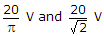
C:
D:
Answer: A

.

Regulation of the DC power supply of 12 V, 100 mA is the effective resistance of power supply is 20 Ω
A:
22%
B:
131%
C:
30%
D:
20%
Answer: D

.

The slew rate of an ideal op-amp is
A:
very slow
B:
slow
C:
fast
D:
infinitely fast
Answer: D

Slew rate signifies the fastest change which can occurs in output voltage. In an ideal op-amp the output can change instantaneously.

Ad Slot (Above Pagination)
Quiz